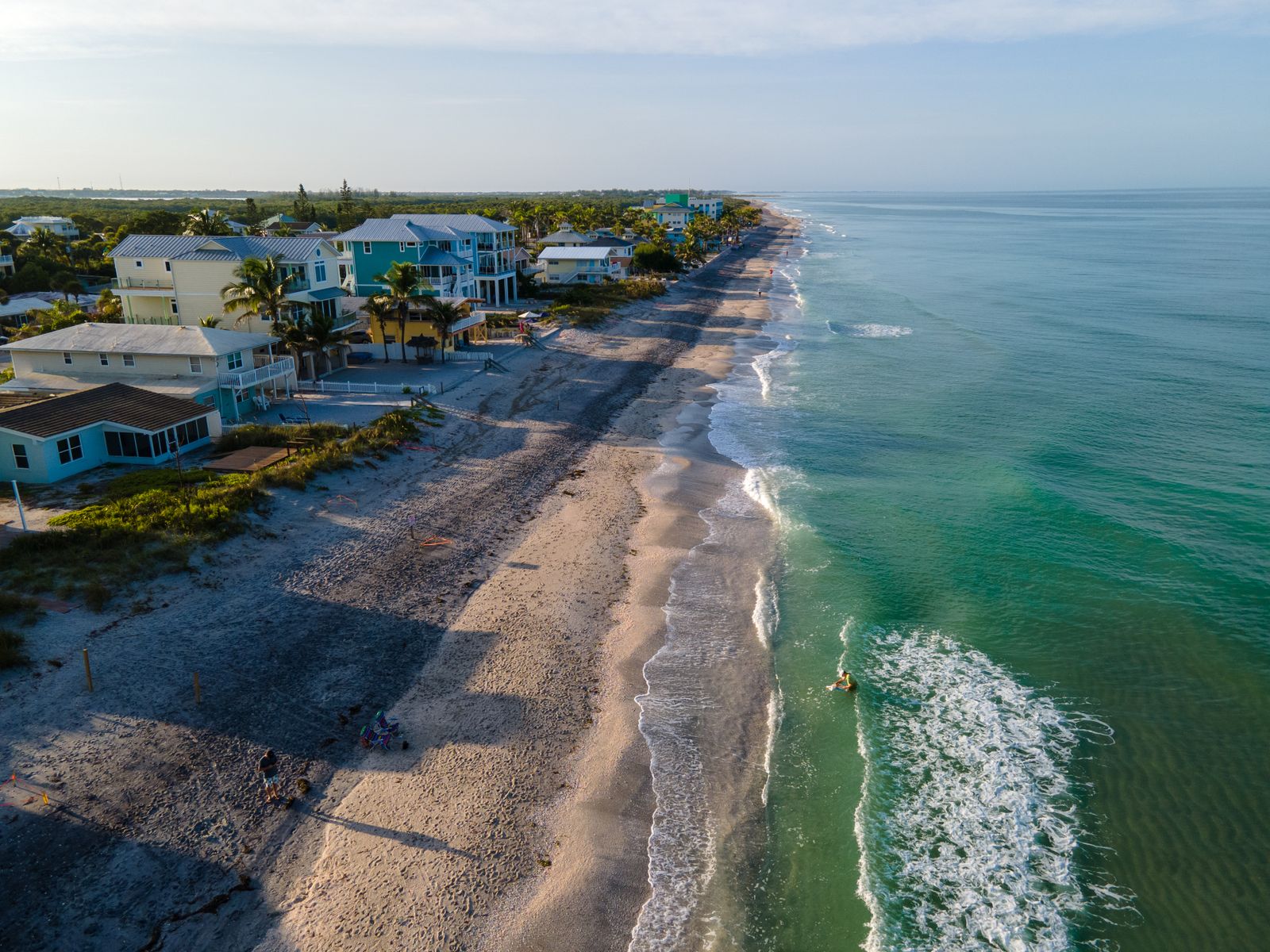
Sewer blockages in Golden Beach, Venice, start in the buried pipe that carries waste from a house to the public main, and they usually announce themselves with a small sign: a toilet that gurgles after the washer runs, a floor drain that is slow, or a damp patch in the yard near the slab. At the south end of the island the ground itself works against buried pipe, so a small symptom can mean the line has been struggling for a while.
What makes Golden Beach homes different underground
Golden Beach sits on the southern stretch of Venice Island, in the streets south of Venice Avenue that lean toward the Gulf. The housing is mostly single-family, and the lots tend to be small, smaller than what you find on the mainland side of the Intracoastal.
Most homes here are built on a slab. That matters because the sewer line often leaves the house through or right beside the slab, then crosses a short stretch of sandy yard to reach the main. A small lot means a short lateral, but it also means the pipe is never far from a foundation edge, a hedge, a tree or a paved parking pad.
Older homes may still have cast iron or clay pipe under or near the slab, while newer construction is mostly PVC. Those are tendencies, not rules, and a single block can hold both.
The soil is the other half of the story. Beach sand drains quickly on the surface, yet the water table sits close to the top, so a trench or access pit can fill with groundwater almost as fast as it is dug. Sand also shifts. A pipe that was laid straight can settle into a belly over time, and a joint that was tight can drift apart.
Describe the problem and dispatch a pro
Where slab drain lines go wrong near the Gulf
Three problems come up again and again on these streets. The first is ground movement. Sand settles unevenly under a pipe, and the result is a sag where water and solids sit instead of moving on to the main.
The second is wet weather. Heavy weather can leave low streets wet, and a sewer line that is already cracked or offset can start to take groundwater in. The result looks like a backup even when nothing is wrong inside the house, and only a camera run can show what a given line is doing.
The third is root entry. Even on small lots there are trees and shrubs, and their roots push toward any joint that leaks moisture. If you have had a drain cleared and roots came out, the line needs a look rather than another cleaning.
Exposed metal near the beach may also corrode faster than it would inland, which can matter for older fittings and cleanout hardware above ground.
- Slow drains that return soon after being cleared
- Gurgling in a tub or shower when a toilet flushes
- Sand or silt showing in a cleanout or at a low fixture
- A damp, sunken or unusually green strip between the house and the street
- A sewage smell near the slab or the cleanout
When several drains slow down together, a sewer backup call is the right place to start.
Golden Beach slab drain lines on camera
Golden Beach slab drain lines are a good fit for a camera look, because the lateral is short. A small camera on a flexible cable goes in through the cleanout, and the tech watches the pipe wall as it travels toward the main. The picture is usually clear, and it tells the technician far more than a guess based on symptoms.
The tech is looking for specific things:
- Sags where sand has shifted beneath the pipe and water now pools
- Offset or separated joints, where one section has slipped from the next
- Fine sand inside the pipe, which can point to a break letting soil in
Beach lot sewer pipe: first checks on a short lateral
The first check is where the beach lot sewer pipe leaves the house. On a slab home the tech locates the cleanout, or, if there is none, looks for another way to get a camera in. Older homes sometimes have no outdoor cleanout at all, or one buried under sand and mulch. Adding one is often part of the plan, and the page on sewer cleanout installation explains why it makes later work easier.
Then comes the material question. If the pipe turns out to be old cast iron, the conversation moves toward whether a section or the whole run should be replaced, and the page on cast iron sewer pipe replacement lays out how that decision usually goes. Only after seeing the full picture does the tech talk about options such as a spot fix, a lined pipe or a dig, and what each would involve on your lot.
Clearing sewer blockages in Golden Beach when sand limits the dig
Fixing a blocked or failing pipe in Golden Beach has to fit the site. Open trench work in sand with a high water table can mean pumping out the excavation and shoring the sides, and on a narrow lot there may not be much room for equipment. Trenchless methods can sometimes avoid a long trench, though they need a pipe that is in good enough shape to accept them.
A spot fix makes sense when the camera shows one failed joint or one short bad section and the rest of the run is sound. A longer run of new pipe makes more sense when the pipe is sagging, scaled or broken in several places. The plan is explained before any work begins.
How a call about sewer blockages in Golden Beach goes
The phone is answered at any hour, and the first questions are simple: which drains are slow, whether anything has backed up, and when it began.
Then a local pro is dispatched, with same-day and emergency dispatch where available. At the house the tech finds access, runs the camera, shows you the footage and explains the options in plain words. Nothing is proposed before the pipe has been seen.
Nearby areas and related services
If you live on the mainland side, the same approach applies with different details. Condo and villa communities across the waterway bring shared-line questions, covered on the page for sewer clogs in Bird Bay. Newer subdivisions with wider lots are covered on the page for sewer damage in Pinebrook.
For the full picture of what local pros cover across the city, the home page on sewer line repair venice shows every service in one place.